

A 9-year-old typically swings a 27–28 inch bat, a 10-year-old 28–29 inches, and a 12-year-old 30–31 inches. Age gets you close, but height and weight decide it. Two 9-year-olds four inches apart in height need different bats, and the height-and-weight chart further down this page is the one to trust when they disagree.
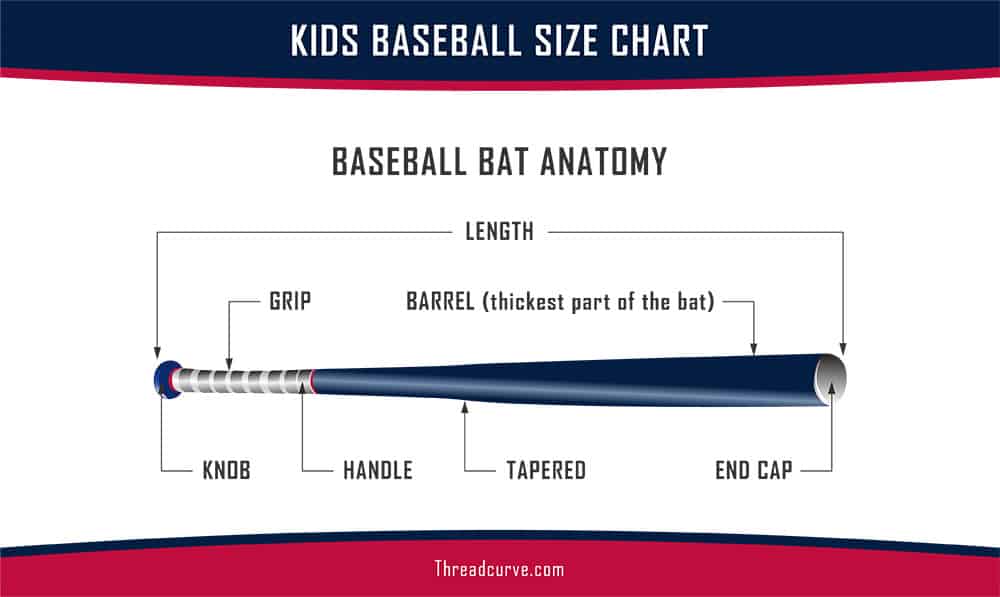
There are three numbers that matter on a youth bat: length (how far the barrel reaches), weight (how fast they can get it round), and drop — the difference between the two. A 28-inch bat weighing 18 ounces is a drop 10. The bigger the drop number, the lighter the bat for its length, and the easier it is for a young hitter to control.
What size bat for a 5, 7, 8, 9, 10, 11 or 12 year old?
Use age only as a starting point. Find the age band, then confirm against the height-and-weight chart below before buying.
| Age | Bat length |
|---|---|
| 5–7 years | 24″–26″ / 61.0–66.0 cm |
| 8–9 years | 26″–28″ / 66.0–71.1 cm |
| 10 years | 28″–29″ / 71.1–73.7 cm |
| 11–12 years | 30″–31″ / 76.2–78.7 cm |
| 13–14 years | 31″–32″ / 78.7–81.3 cm |
| 15–16 years | 32″–33″ / 81.3–83.2 cm |
| 17–18 years | 32″–34″ / 81.3–86.4 cm |
Bat length by height and weight
This is the chart to use if you only use one. Find your child’s weight down the left, their height across the top, and read off the bat length in inches. Where the age chart and this chart disagree, follow this one — a tall, light 10-year-old and a short, heavy 10-year-old do not swing the same bat.
| Weight | 3’–3’4″ | 3’5″–3’8″ | 3’9″–4′ | 4’1″–4’4″ | 4’5″–4’8″ | 4’9″–5′ | 5’1″–5’4″ | 5’5″–5’8″ | 5’9″–6′ | Over 6’1″ |
|---|---|---|---|---|---|---|---|---|---|---|
| Under 60 lb | 26″ | 27″ | 28″ | 29″ | 29″ | 29″ | 29″ | 30″ | 31″ | 31″ |
| 61–70 lb | 27″ | 27″ | 28″ | 29″ | 30″ | 30″ | 30″ | 31″ | 31″ | 31″ |
| 71–80 lb | 27″ | 28″ | 28″ | 29″ | 30″ | 30″ | 31″ | 31″ | 31″ | 32″ |
| 81–90 lb | 27″ | 28″ | 29″ | 29″ | 30″ | 30″ | 31″ | 32″ | 32″ | 32″ |
| 91–100 lb | 27″ | 28″ | 29″ | 30″ | 30″ | 31″ | 31″ | 32″ | 32″ | 32″ |
| 101–110 lb | 28″ | 29″ | 29″ | 30″ | 30″ | 31″ | 31″ | 32″ | 32″ | 32″ |
| 111–120 lb | 28″ | 29″ | 29″ | 30″ | 30″ | 31″ | 31″ | 32″ | 32″ | 33″ |
| 121–130 lb | 28″ | 29″ | 30″ | 30″ | 30″ | 31″ | 32″ | 33″ | 33″ | 33″ |
| 131–140 lb | 28″ | 29″ | 30″ | 30″ | 31″ | 31″ | 32″ | 33″ | 33″ | 33″ |
| 141–150 lb | 29″ | 29″ | 30″ | 30″ | 31″ | 31″ | 32″ | 33″ | 33″ | 33″ |
| 151–160 lb | 29″ | 29″ | 30″ | 31″ | 31″ | 32″ | 32″ | 33″ | 33″ | 33″ |
| 161–170 lb | 29″ | 29″ | 30″ | 31″ | 31″ | 32″ | 32″ | 33″ | 33″ | 34″ |
| 171–180 lb | 29″ | 29″ | 30″ | 31″ | 31″ | 32″ | 33″ | 33″ | 34″ | 34″ |
| Over 180 lb | 30″ | 30″ | 31″ | 31″ | 32″ | 32″ | 33″ | 33″ | 34″ | 34″ |


How to check bat length at home
Two checks, thirty seconds, no tape measure needed. Both are the tests coaches use at the start of a season.
- The arm test. Stand the bat upright on the ground beside your child, knob up. The knob should reach somewhere between the middle of their palm and their wrist. Past the wrist and the bat is too long.
- The reach test. Have them hold the bat out to the side with one arm straight, gripping the knob. If they can hold it steady for 20–30 seconds without the barrel dropping, they can control it. If the end sags, it is too heavy for them regardless of what the chart says.
Between the two, the reach test matters more. A bat that is technically the right length but too heavy produces a slow, late swing — and a child who stops enjoying hitting.
What drop weight should a youth bat be?
Most youth players should be on a drop 10 to drop 12. Younger and lighter players want the bigger drop (lighter bat), and as they get stronger the drop comes down toward the drop 3 used at high school and college level. If your child is between two bats, take the lighter one — bat speed beats bat mass at every youth level.
Is a bigger bat better as they grow into it?
No. This is the most common and most expensive mistake in youth baseball. Clothing you size up; bats you do not. A bat two inches too long changes where the barrel meets the ball, slows the swing, and teaches a compensating motion that takes a season to unlearn. Buy the bat that fits this year.
League rules: check before you buy
Length and weight are only half the decision — the bat also has to be legal for the league your child plays in, and the standards changed significantly in recent years.
- Little League and most youth baseball require bats carrying the USA Baseball (USABat) stamp. Bats made to the older standard are no longer permitted.
- USSSA travel ball uses a different mark (the USSSA thumbprint) and permits higher-performance barrels. A USSSA bat is generally not legal in Little League play, and vice versa.
- Barrel diameter is capped in most youth divisions, commonly at 2⅝ inches.
Confirm the current requirement with your specific league before ordering. A bat that fits perfectly and cannot be used in a game is still the wrong bat.
Sources and verification
The length figures above are standard youth bat sizing tables in general use across US youth baseball. Bat certification requirements come from Little League Baseball and USA Baseball; travel-ball requirements from USSSA. Manufacturers grade slightly differently and league rules are revised periodically — check your league’s current rule and the specific bat’s certification stamp before buying.
Last verified: 5 August 2026. Spotted a number that looks wrong? Tell us — corrections get the chart re-checked and re-dated.