

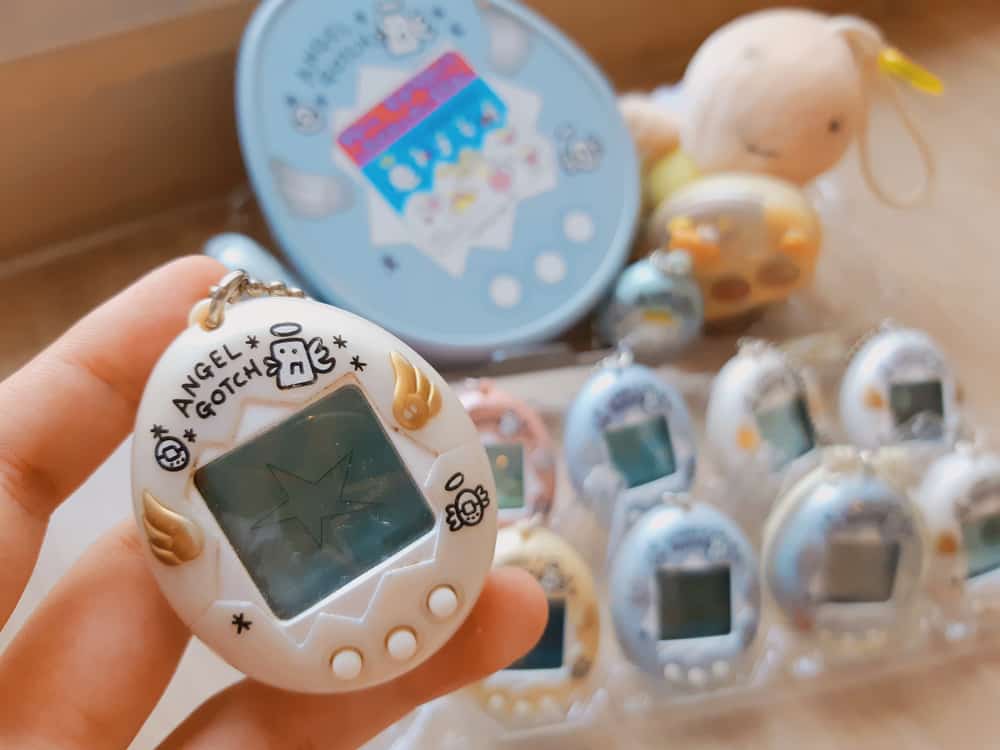
If you want something your child can actually own this week, the two real options are the Tamagotchi Uni (Bandai’s current model) and the Bitzee from Spin Master. Everything else people name — Giga Pets, Nano Pets, Digimon, the Pokémon Pikachu — came out in the late 1990s and has been out of production for decades. They are collector items now, not toys you order.
That distinction is the whole problem with this question. Search for “toys like Tamagotchi” and you get lists of 1990s products presented as though you could add them to a basket. Below, the two lists are kept separate: what you can buy, and what you are remembering.


Virtual pets you can actually buy today
Two toys dominate the current shelf, and they are aimed at different children. The Tamagotchi Uni is the direct descendant of the original — a small screen pet you feed and raise, now with an online layer. The Bitzee is a different idea altogether: a touch-responsive pet that appears to float above the device, aimed at younger children who want to poke rather than manage.
| Toy | Maker | What it is | Best for |
|---|---|---|---|
| Tamagotchi Uni | Bandai | Wrist-worn virtual pet with online connection (the “Tamaverse”) — visit friends’ pets, trade gifts, take part in events | Ages 8+ who want the full raising-a-pet routine |
| Bitzee | Spin Master | Touch-responsive digital pet, 15 animals to unlock, reacts to swipes, tilts and shakes; grows baby → adult → Super Bitzee | Ages 5–8, and anyone who finds button menus fiddly |
Tamagotchi Uni — for the child who wants the real thing
This is Bandai’s current generation, and it does what the 1997 original did plus an online layer. Your child still feeds, cleans and plays with a pet that grows through life stages. What is new is connection: the Tamaverse lets pets visit each other, exchange gifts and join events. It is worn on the wrist rather than clipped to a bag, which solves the single biggest failure mode of the original — being left in a coat pocket until the pet died.
Bitzee — for younger hands
The Bitzee’s display makes the pet appear to sit just above the surface, and it responds to touch rather than to button presses. That matters more than it sounds for a five- or six-year-old: the original Tamagotchi’s three-button menu system is genuinely fiddly for small fingers, and a lot of young children lose interest at the menu rather than at the pet. There are 15 animals to unlock, which gives it a collecting hook the original never had.
What is a Tamagotchi?
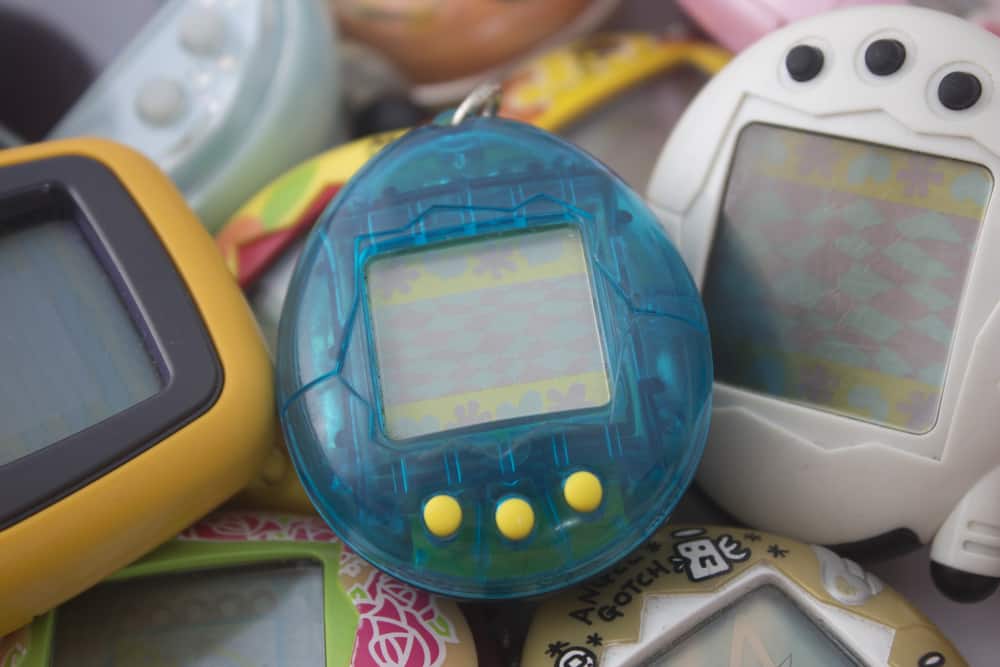
A Tamagotchi is a keychain-sized virtual pet made by Bandai that hatches, grows and eventually dies depending on how well it is cared for. It launched in Japan in the mid-1990s and became one of the defining toys of the decade — feed it, clean up after it, play with it, and it grows into a healthy adult; ignore it, and it does not.
The original had a black-and-white screen a few centimetres across and three buttons. There was no pause, no save and no forgiveness, which is exactly why children carried them everywhere and why so many were confiscated in classrooms.
90s toys like Tamagotchi: the originals
These are the five most commonly named alternatives, and all of them are long out of production. You will find them on eBay and in collector shops, usually untested and often with a dead battery seal. They are worth knowing about if you are buying nostalgia for an adult — they are not a practical choice for a child today.
Giga Pets
Tiger Electronics’ answer to the Tamagotchi, and the closest competitor at the time. Giga Pets offered a wider range of creatures than the original, with slightly more involved care routines. The brand has resurfaced periodically in re-release form, so check whether a listing is an original or a reissue before paying collector prices.
Nano Pets
Smaller and simpler, sold in large numbers as the cheaper option on the same shelf. The care loop was shorter, which made them easier for younger children at the time and less interesting after a fortnight.
Pokémon Pikachu
Nintendo’s version, and the one that did something genuinely different: it contained a pedometer, and walking with it earned points to spend on your Pikachu. It is the ancestor of every step-counting toy since.
Digimon
Bandai’s other virtual pet, and the one built around conflict rather than care. Two Digimon devices could connect and battle each other, which turned it into a playground activity in a way the solo Tamagotchi never was.
Think Ways Virtual Friends
A lesser-known entry from the same wave, following the same feed-clean-play loop. Included here because it comes up in searches, not because it is easy to find.
If it is the interactive-pet idea your child likes rather than the screen specifically, two neighbours are worth a look: toys like Furby covers the talking, reacting kind, and toys like Hatchimals the hatch-and-raise kind.
How to choose one for your child
Three questions settle it, and none of them is about the price.
- How old are they? Under about seven, the button-menu style of the classic Tamagotchi is a real barrier — a touch-responsive pet holds attention far better. From eight upward, the menus stop being an obstacle and the depth becomes the appeal.
- Do they want to collect, or to commit? A pet that unlocks new animals rewards dipping in and out. A single pet you raise over weeks rewards the opposite. Buying the wrong one for the temperament is how these end up in a drawer.
- Who is going to deal with it at 6am? Virtual pets beep. Some models can be muted, some cannot, and a pet that needs attention overnight becomes a parent’s problem. Check the mute options before you buy, not after.
A note on buying the 90s originals secondhand
If you are set on an original, two things to check: whether the battery compartment has corroded (the most common reason a listed unit does not work), and whether the screen has bleed at the edges. Listings often omit both, so ask before bidding. Prices on genuinely working units have risen sharply, and a reissue often plays better than a thirty-year-old original.
Frequently asked questions
What is another name for a Tamagotchi?
“Virtual pet” or “digital pet” is the generic term. Tamagotchi is a Bandai trademark, so competing products use those descriptions instead — which is why searching the brand name alone misses most of the current shelf.
Which is better, a Tamagotchi or a Giga Pet?
For a child today, the question is mostly settled by availability: the Tamagotchi line is in production and Giga Pets largely are not. Compared at their peak, Giga Pets offered more creature variety while the Tamagotchi had the deeper life-stage system.
How much is a virtual pet?
Current models are priced as mainstream toys rather than collectibles — the Bitzee launched at $29.99, and the connected Tamagotchi models sit higher. Sealed 1990s originals are priced as collectibles rather than as toys and vary enormously.
Can a Tamagotchi die?
Yes — that is the design. Neglect it long enough and it dies, and depending on the model you either reset and start over or hold a small funeral, according to household custom. Worth knowing before you hand one to a sensitive six-year-old on a school night.
Which Tamagotchis are worth money?
Sealed first-run units from the original 1990s release command the highest prices, along with limited regional editions. Condition and packaging drive the value far more than the model does — a loose, working unit is worth a fraction of a sealed one.
Sources and verification
Current-model details for the Tamagotchi Uni are taken from Bandai’s own product listing; Bitzee details from Spin Master’s launch materials and retail listings, cross-checked against independent coverage. The 1990s products are described from their documented original release and are noted as out of production rather than presented as purchasable. Prices move constantly and are given as broad ranges only — check current listings before buying.
Last verified: 7 August 2026. Spotted something that looks wrong? Tell us — corrections get the page re-checked and re-dated.