

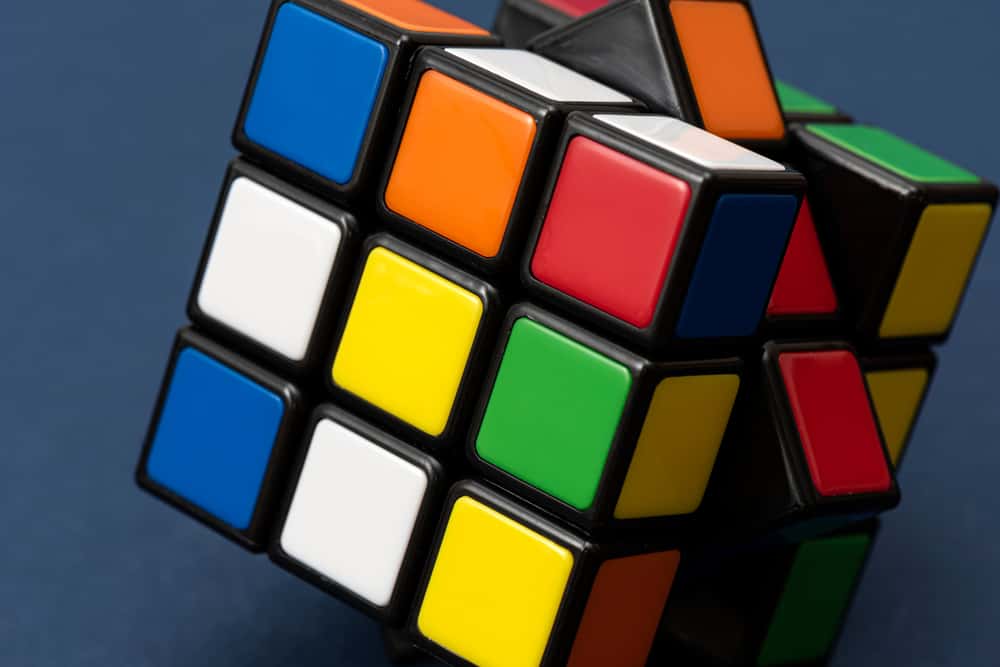
The closest toys to a Rubik’s Cube are other twisty puzzles: a 2×2 cube if the 3×3 is still too hard, a Pyraminx or Skewb for something new that stays beginner-friendly, and a 4×4, Mirror Cube or Megaminx once the 3×3 is solved. For a puzzle that is not a cube at all, Perplexus Fusion, Kanoodle and Hanayama cast-metal puzzles scratch the same “work it out in your hands” itch.
Below are 12 picks, grouped by type and ordered from easiest to hardest. Every product link was checked as in stock on Amazon on the date at the bottom of this page, and the star ratings are Amazon customer ratings from that same check. We are not a testing lab, so difficulty is judged from something anyone can check: how fast the world’s best solvers finish each puzzle in official competition.
Quick Pick: Which Rubik’s-Style Puzzle Fits Your Kid?
The world-record column is the most honest difficulty scale there is. A 3×3 Rubik’s Cube record is 2.76 seconds; a puzzle with a record well under that is easier, and one with a record several times longer is a real step up.
| Puzzle | What it is | Compared with a 3×3 | WCA world record (single) |
|---|---|---|---|
| 2×2 cube | Corners-only cube | Easier | 0.39 s |
| Pyraminx | Four-sided pyramid | Easier | 0.73 s |
| Skewb | Cube that turns around its corners | Easier, but new | 0.73 s |
| 3×3 Rubik’s Cube | The original | Baseline | 2.76 s |
| 4×4 cube | Bigger cube, no fixed centers | Harder | 15.18 s |
| Megaminx | 12-sided dodecahedron | Much longer | 21.04 s |
| Mirror Cube | 3×3 solved by shape, not color | Harder | Not a WCA event |
| Ghost Cube | 3×3 cut at odd angles | Much harder | Not a WCA event |
WCA is the World Cube Association, the body that runs official speedcubing competitions. Records are as listed in September 2026 and change often.
What Is the Rubik’s Cube, and Who Makes It Now?
The Rubik’s Cube is a 3x3x3 twisting puzzle invented in 1974 by Ernő Rubik, a Hungarian architect and design teacher, and first sold in Hungary as the Magic Cube. Ideal Toy Corp. licensed it for worldwide release in 1980. A scrambled cube can land in about 43 quintillion positions, yet any of them can be solved in 20 moves or fewer.
Ownership has changed hands since. Toronto toymaker Spin Master bought Rubik’s Brand Ltd. for US$50 million in January 2021, which is why today’s Rubik’s cubes, the Rubik’s Twist and the Perplexus Fusion further down all carry the same brand. Plenty of other companies make cubes too; people still call them all “Rubik’s cubes,” but only the Spin Master ones carry the name.
Puzzles Like Rubik’s Cube: Twisty Puzzles, Easiest to Hardest
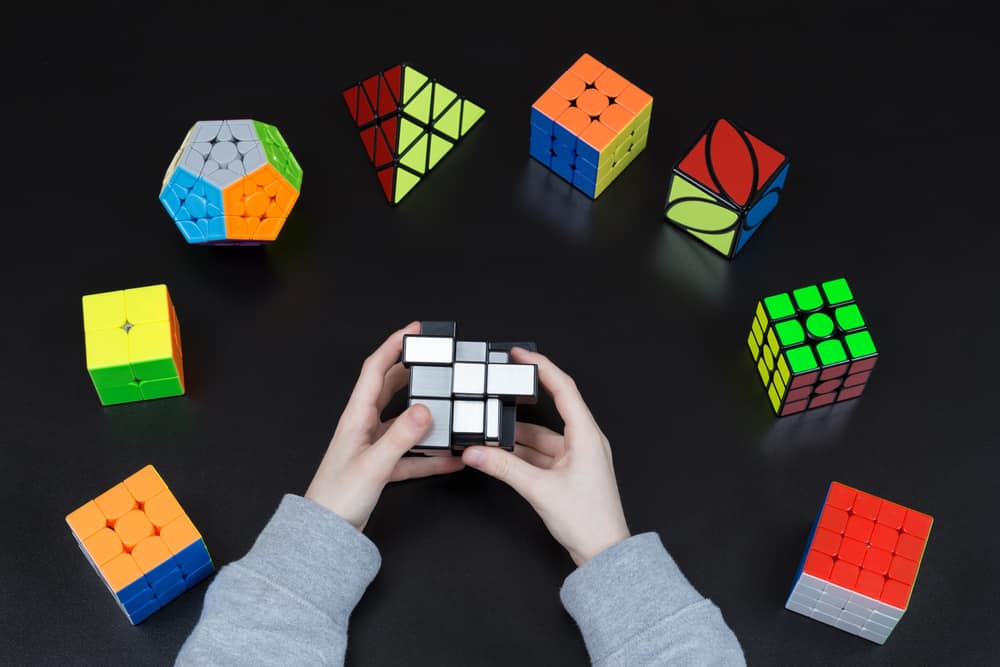
“Twisty puzzle” is the name for the whole family the Rubik’s Cube belongs to: shapes whose layers rotate to scramble and unscramble colors. If a kid likes the cube, a twisty puzzle is the safest next buy, because the skills carry over. The seven below run from a warm-up to a genuine challenge.
1. 2×2 Cube (QiYi Qidi)

The 2×2 (also called the Pocket Cube) is a Rubik’s Cube with only the eight corner pieces. There are no edges or centers to think about, so it is the best first win for a kid who keeps getting stuck on the 3×3, and the corner moves learned here are the same ones used to finish a 3×3. The QiYi Qidi is a low-cost starter version rated 4.5 stars from 1,416 reviews. See the QiYi Qidi 2×2 on Amazon.
2. Pyraminx (D-FantiX Qiming)

The Pyraminx is a four-sided pyramid whose layers and tips all turn. It looks harder than a cube and is actually easier: the four tips can be twisted into place on their own, which leaves very little to solve. That combination makes it a confidence builder for younger kids. The D-FantiX Qiming is a stickerless version rated 4.6 stars from 2,041 reviews. See the Qiming Pyraminx on Amazon.
3. Skewb (D-FantiX Qicheng)

A Skewb is shaped like a cube but turns around its corners instead of its faces, so each twist moves half the puzzle at an angle. Kids who have memorized 3×3 moves find it disorienting at first, which is the point: it forces fresh thinking without being long. The D-FantiX Qicheng is rated 4.6 stars from 602 reviews. See the Qicheng Skewb on Amazon.
4. Rubik’s 4×4 Master

The 4×4, first sold as Rubik’s Revenge, is the natural step up once a kid can solve the 3×3 without help. It has no fixed center pieces, so the first job is building the centers and pairing edges, after which it solves like a 3×3. It adds one new headache, called parity, where the cube ends in a position a 3×3 can never reach. The official Rubik’s version is rated 4.5 stars from 906 reviews and is labeled for ages 8+. See the Rubik’s 4×4 Master on Amazon.
5. Mirror Cube (ShengShou Gold)

A Mirror Cube works exactly like a 3×3 inside, but every piece is the same color and a different size. Scramble it and it turns into a lumpy block; the goal is to get it back to a cube by reading shapes instead of colors. A kid who can already solve a 3×3 has everything needed, which makes it a satisfying twist on a solved problem. This D-FantiX ShengShou gold version is rated 4.6 stars from 3,095 reviews. See the gold Mirror Cube on Amazon.
6. Megaminx (D-FantiX Cyclone Boys)

The Megaminx is a 12-sided dodecahedron with 50 moving pieces. The method is close to a 3×3, just longer: the world record is 21.04 seconds against 2.76 for the 3×3, which tells you how much more patience it asks for. It suits a kid who likes the 3×3 and wants a longer project rather than a new trick. The Cyclone Boys version is rated 4.6 stars from 1,999 reviews. See the Cyclone Boys Megaminx on Amazon.
7. Ghost Cube (Cuberspeed)

The Ghost Cube is a 3×3 mechanism cut at odd angles so that no two pieces share a shape. Like the Mirror Cube it is solved by shape, but the cuts are far less regular, and it is widely treated as one of the hardest 3×3 variants a hobbyist can buy. Save it for a kid who has already finished the Mirror Cube. The Cuberspeed version is rated 4.2 stars from 252 reviews, and stock was limited on the check date. See the Cuberspeed Ghost Cube on Amazon.
Rubik’s-Brand Twists on the Classic
Rubik’s itself still makes new takes on the cube. These two keep the brand but change what the challenge is: one hides the colors, the other drops the cube shape altogether.
8. Rubik’s Phantom

The Phantom is a 3×3 whose stickers look black until they are warmed by a finger, then fade back. The solve is the same as a normal cube, but the kid has to remember where colors are instead of seeing them, which turns a solved skill into a memory game. It is rated 4.5 stars from 3,351 reviews. See the Rubik’s Phantom on Amazon.
9. Rubik’s Twist

Rubik’s Twist is a chain of 24 hinged prisms, the modern name for the Rubik’s Snake that Ernő Rubik released in 1981. There is nothing to “solve”: kids bend it into animals and objects, often from a picture. It is the pick for a child who likes fiddling with the cube more than following an algorithm. Labeled for ages 8+, rated 4.7 stars from 146 reviews. See the Rubik’s Twist on Amazon.
Brain Teasers Like Rubik’s Cube That Aren’t Cubes
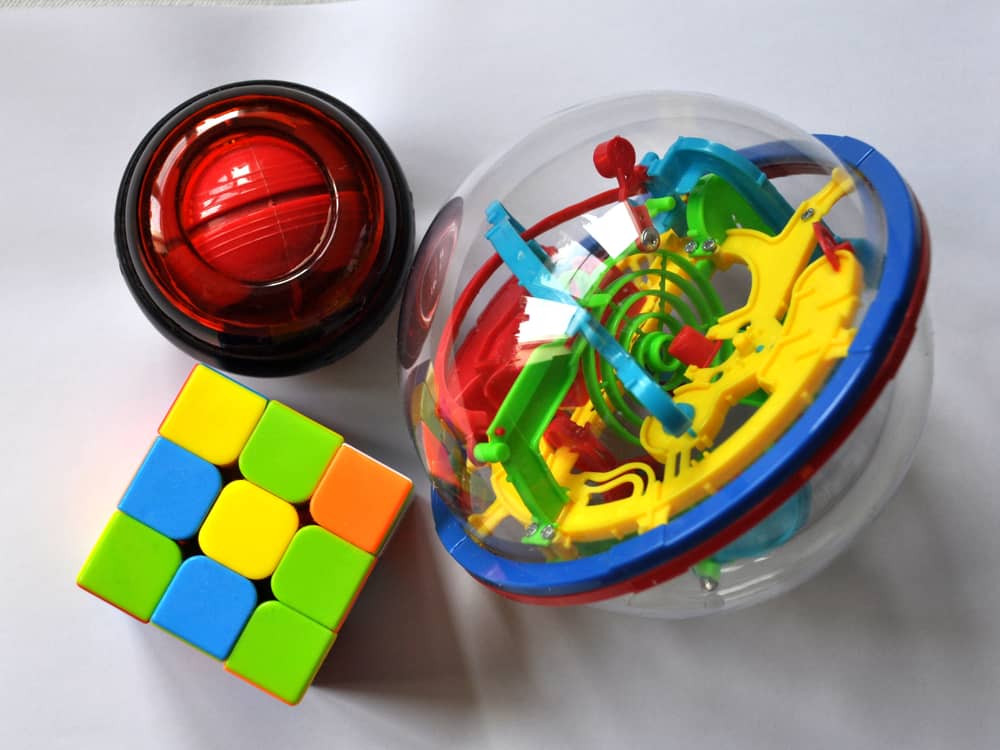
Some kids love the cube for the twisting; others love it for the moment the answer clicks. These three keep the second part and change the first, which makes them good gifts for a child who already owns every cube.
10. Rubik’s Perplexus Fusion

Perplexus started as a marble maze sealed inside a clear ball. The Fusion puts a twistable 3×3 cube inside the ball: kids turn the layers to line up the track, then tilt the whole thing to roll the marble through. It is the most direct bridge on this list between a cube fan and a maze fan. Labeled for ages 8+, rated 4.4 stars from 1,670 reviews. See the Perplexus Fusion on Amazon.
11. Hanayama Cast Enigma

Hanayama makes palm-sized cast-metal puzzles: take the interlocked pieces apart, then put them back. The Enigma is rated Level 6, the top of Hanayama’s difficulty scale, and the listing is marked for ages 12 and up, so it is a teen pick rather than a stocking stuffer for a young child. Hanayama makes easier levels in the same style if Level 6 is too much. Rated 4.7 stars from 10,539 reviews. See the Hanayama Enigma on Amazon.
12. Kanoodle

Kanoodle from Educational Insights is a flat case of bead-shaped pieces and a booklet of challenges: some pieces are placed for you, and the job is fitting the rest. There is no twisting at all, but it trains the same spatial reasoning, and it travels well. With 35,211 reviews at 4.7 stars, it is the most-reviewed product on this page. See Kanoodle on Amazon.
Speed Cube or Official Rubik’s Cube: Which Should a Kid Start With?
For learning, either works; for speed, most kids end up on a speed cube. Speed cubes from brands like QiYi, MoYu and GAN are built to turn loosely and forgive slightly misaligned layers, many use magnets to settle each turn, and they are usually cheaper than the branded cube. Official WCA competitions do not require the Rubik’s brand, so a speed cube is legal at any event.
The case for the original Rubik’s 3×3 (4.7 stars from 10,751 reviews) is simpler: it is the one in most classroom sets and tutorial videos, and it makes a better gift box. If a kid is getting frustrated because the cube “catches” mid-turn, a speed cube usually fixes that for less money.
Collector Pieces and Puzzles That Are Hard to Find Now
An earlier version of this page linked to a few puzzles that can no longer be bought new. They are worth knowing about if you collect, but do not count on finding them in a store:
- Rubik’s Tangle: a tile puzzle where colored “strings” printed on square tiles must line up across the whole board. The Amazon listing now reads “Currently unavailable,” so it is secondhand only.
- Rubik’s Domino: a flat 3x3x2 puzzle with domino dots instead of colors. We found no current Amazon listing for it.
- Impossiball: a ball-shaped twisty puzzle from the early 1980s, marketed by puzzle maker Uwe Mèffert. We found no current Amazon listing for it either.
What we removed and why. We dropped the “Rubik’s UFO” because we could not confirm it as a Rubik’s-brand product and the old link went to a generic eBay category page. We removed a claim that a “Pentamix” with “975 parts” is the hardest cube variant, because we could not find a source for it. We also corrected three errors from the earlier version: official competitions are run by the World Cube Association (not by the Rubik’s brand, and not in teams), a cube cannot become unsolvable through normal turning, and the Tamagotchi dates from 1996, not the 1960s.
Common Mistakes When Buying a Rubik’s-Style Puzzle
- Assuming a different shape means harder. The Pyraminx and Skewb look exotic but are easier than a 3×3; both have world records under one second.
- Jumping straight to a big project. A Megaminx or 4×4 given to a kid who has not solved a 3×3 usually ends up on a shelf. Solve the 3×3 first, then step up one puzzle at a time.
- Giving a Mirror or Ghost Cube as a first cube. They are 3x3s solved by shape, so they reward kids who already know the 3×3 method and stall kids who do not.
- Buying a keychain mini for practice. Tiny cubes are fun fidgets, but they are hard to turn quickly and hard to read, which makes learning slower.
- Skipping the age label on metal puzzles. Hanayama’s harder levels are listed for ages 12 and up for a reason; match the level to the kid.
Other Classic Toys From the Rubik’s Cube Era
The cube shared toy shelves with a few other icons that still sell today. The Cabbage Patch Kids doll, with its “adoption papers,” was the must-have toy of the 1983 holiday season. The View-Master, a red stereo viewer that clicks through picture reels, dates back to 1939 and was a staple through the 1970s and 1980s. The Tamagotchi came later, in 1996, and if a kid’s interest is looking after a digital pet rather than solving a puzzle, our guide to toys like Tamagotchi covers that side of the shelf.
Toys Like Rubik’s Cube FAQs
What age is a Rubik’s Cube for?
Rubik’s labels its cubes for ages 8 and up, which matches when most kids can follow a written or video method. Younger kids can do it: the 3×3 record set in 2025 by Xuanyi Geng, at 3.05 seconds, came from a 7-year-old. For a kid under 8, a 2×2 or Pyraminx is the gentler start. For other puzzle and building picks at that age, see our list of educational toys for 8-year-olds.
What is the fastest Rubik’s Cube solve?
The official 3×3 world record single is 2.76 seconds, set by Teodor Zajder of Poland at GLS Big Cubes Gdańsk in February 2026. Robots are faster: a machine built by Purdue University students holds the Guinness World Record at 0.103 seconds (2025), beating Mitsubishi Electric’s 0.305 seconds from 2024.
Are there Rubik’s Cube competitions for kids?
Yes. The World Cube Association sanctions official competitions worldwide, and kids compete in the same events as adults. Each competitor solves on their own; there are no team events. Any brand of cube is allowed, and events include the 2×2, 4×4, Pyraminx, Skewb and Megaminx from this list, so a kid who likes one of them has something to practice toward.
Can a Rubik’s Cube be unsolvable?
Not from normal turning. Every position reachable by twisting can be solved. A cube only becomes unsolvable if someone pops it apart and reassembles it wrong, or twists a single corner in place; put back at random, only 1 in 12 reassemblies is solvable. The fix is to take it apart again and rebuild it in the solved state.
What is the hardest puzzle like a Rubik’s Cube?
Among the puzzles on this page, the Megaminx takes longest to solve at the top level, and the Ghost Cube is the hardest to figure out, because every piece is a different shape. Beyond this list, much larger cubes such as 7×7 and bigger are mostly a test of patience rather than new ideas.
Do puzzles like the Rubik’s Cube make kids smarter?
They make kids better at puzzles; the evidence that they raise general intelligence is weak. Studies of “brain training” generally find people improve at the task they practice, with little transfer to unrelated skills. The more realistic benefits are practice at sticking with a hard problem and following a multi-step method, and Rubik’s runs a classroom program, You Can Do the Rubik’s Cube, built on exactly that.
Sources and Verification
Product availability, star ratings and review counts come from each product’s Amazon listing, checked in a live browser on the date below; two products from the earlier version (Rubik’s Tangle and the Project Genius Ghost Cube) were listed as “Currently unavailable” and were replaced or moved to the collector section. World-record times are the World Cube Association singles as listed in September 2026. The robot records come from Purdue University’s Elmore Family School of Electrical and Computer Engineering (0.103 s) and Mitsubishi Electric (0.305 s). The Spin Master purchase of Rubik’s Brand is from the company’s January 2021 announcement as reported by Global News and The Globe and Mail. Where a source and our older copy disagreed, we corrected the page and listed the change above.
Last verified: September 27, 2026. Spotted a discontinued product or a record that has been broken? Tell us through the contact page and we will update it.