

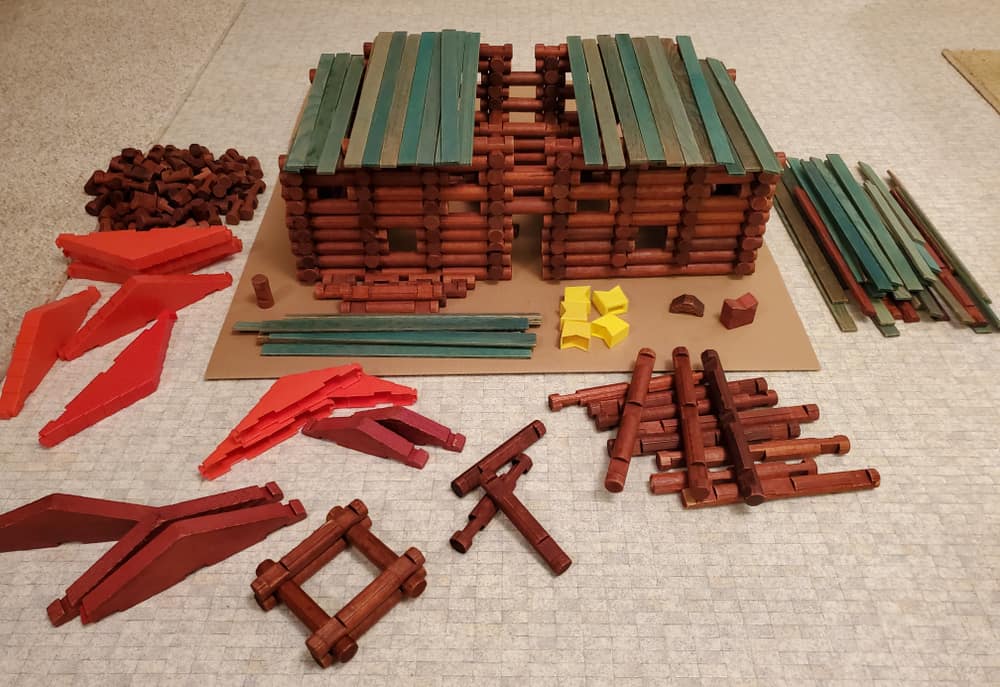
If you want the same toy for less money, the two names people actually compare against Lincoln Logs are Roy Toy and WonderToys. Roy Toy is the closest match in kind — notched pine logs made in Machias, Maine by the same family since 1930. WonderToys is the budget option sold mainly through Amazon. Worth knowing before you shop: Lincoln Logs themselves are also made in Maine now, and their logs are ¾ inch (about 2 cm) in diameter, which is the number that decides whether a rival set will stack with the one you already own.
What actually counts as a toy “like Lincoln Logs”?
This is where most lists go wrong, including an earlier version of this one. Lincoln Logs are not simply “a wooden building toy.” The format is specific:
- Round logs with notches cut near each end. The notches are the whole invention — they let a wall hold itself up at a corner without glue, clips or studs.
- Roof slats and gable pieces that turn a square of walls into a cabin, rather than leaving you with an open box.
- One consistent log diameter across the range, so pieces from different sets in the same brand interlock.
By that test, loose unit blocks, castle block sets and plastic brick systems are all a different toy. They are perfectly good building toys and we cover several below, but if a child asks for “the log ones,” a bucket of maple cubes will not land. The sets that genuinely qualify are Roy Toy, WonderToys, and the vintage Halsam American Logs.
Off-brand Lincoln Logs compared
| Set | Maker | Made in | Wood | Notched log format? | Status |
|---|---|---|---|---|---|
| Lincoln Logs | Basic Fun (IP owned by Hasbro) | Burnham, Maine | Wood, originally redwood | Yes — ¾” diameter | In production |
| Roy Toy | Roy Toy Manufacturing (Dennison family) | Machias, Maine | Eastern white pine | Yes | In production |
| WonderToys | WonderToys | Not published | Natural wood, non-toxic paint | Yes | In production |
| American Logs | Halsam | USA (historic) | Wood, with metal clamps | Yes | Discontinued — collector only |
One caveat on that table, and it is the honest answer to the question most people are really asking. We can source Lincoln Logs’ ¾-inch log diameter, but Roy Toy and WonderToys do not publish theirs, so we are not going to tell you the sets are cross-compatible. If mixing with an existing collection matters to you, measure a log you already own and ask the seller before buying. Treat any site that flatly promises compatibility without a number as guessing.
WonderToys vs Lincoln Logs
WonderToys is the cheaper, larger-count option; Lincoln Logs is the established brand with a documented supply chain. WonderToys sells natural-wood log sets in sizes from 170 to 530 pieces, finished with non-toxic paint and rated for ages 3 and up. Its manufacturing location is not published anywhere we could find, which is the main practical difference: Lincoln Logs states Maine, WonderToys states nothing.
If piece count per dollar is what you are optimizing for, WonderToys wins easily and the format is right. If you care where the toy was made and what is on it, that information exists for Lincoln Logs and Roy Toy and does not exist for WonderToys. Neither answer is wrong — they are just different things to care about, and the choice is easier once you know which one you are making.
Roy Toy vs Lincoln Logs
These are the two most similar sets on the market, and both are made in Maine. Roy Toy has been produced by the Dennison family in Machias since 1930 — founded by Roy K. Dennison, run until his death in 1967, and restarted in 1992 by his grandson Bruce. The logs are Eastern white pine, sustainably harvested in Maine, colored with food-grade dyes. Lincoln Logs is the bigger brand, now sold by Basic Fun and manufactured by Pride Manufacturing in Burnham, Maine.
The interesting wrinkle is that the “made in America” argument people use to pick Roy Toy over Lincoln Logs is weaker than it used to be. Lincoln Logs production ran overseas for years and then moved back to Maine, so both brands now come out of the same state. What is still true is that Roy Toy never left, is a small family operation, and publishes exactly what its wood and dyes are. If that is the reason you were looking for an alternative in the first place, it still holds.

Click image for more info
Who invented Lincoln Logs, and who makes them now?
John Lloyd Wright — second son of the architect Frank Lloyd Wright — invented them around 1916 and received US patent 1,351,086 for a “Toy-Cabin Construction” on 31 August 1920. He said the interlocking foundation of the Imperial Hotel in Tokyo, which he watched his father build, gave him the idea for the notched log.
He made them himself first, through the Red Square Toy Company and then J. L. Wright Manufacturing, and sold the business to Playskool in 1943 for $800. The rights moved on from there; the IP sits with Hasbro, K’NEX took over manufacturing in 2014, Basic Fun bought K’NEX in late 2017, and Pride Manufacturing in Burnham, Maine makes the sets today.
A correction to an earlier version of this page. We previously wrote that John Lloyd Wright made his other building sets “after his father sold the rights” to Lincoln Logs. That is wrong on both counts: Frank Lloyd Wright never owned Lincoln Logs, and it was John himself who sold the company. The invention and the sale were both his.
Two other details worth having. The sets were originally made of redwood, which is why vintage pieces look darker than new ones. And in the 1970s the line briefly went all-plastic before reverting to real wood — so an all-plastic “Lincoln Logs” set is genuine, just from an unloved era.
Other wooden building sets worth knowing
These are not log sets and we are not going to pretend otherwise. They come up because parents shopping for Lincoln Logs are often really shopping for “an open-ended building toy in wood,” and if that is you, these are the ones worth the money.
Imaginarium Timber Logs
The closest of this group to the log format, sold as a bucket of 300 pieces for ages 3 to 6 with a booklet of build ideas. The bucket lid doubles as a shape sorter, and the storage question matters more with these sets than people expect — a set with no container ends up in a drawer.
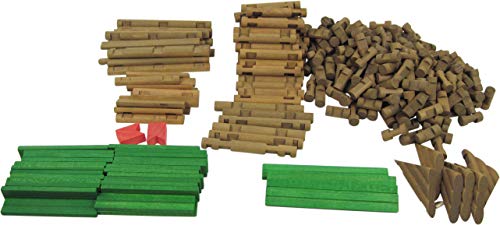
Click image for more info
Eco-Bricks bamboo set
Bamboo blocks that clip together like plastic bricks and are compatible with them, so you can extend a collection you already have rather than starting over. Comes with a wooden storage box. The pieces are small enough to count as a choking hazard, so mind the age rating.
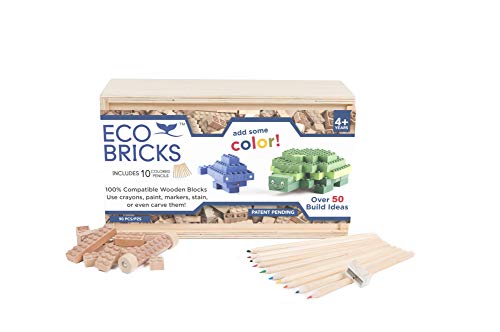
Click image for more info
LEGO and LEGO DUPLO

Different material, different feel, same open-ended purpose. The one genuinely useful fact here is the relationship between the two: DUPLO bricks are twice the size of standard LEGO in each dimension, and the two systems connect to each other. That means a DUPLO set bought for a toddler is not thrown away at five — it keeps working alongside the smaller bricks. For a child under three, the size difference is also the safety difference.
LEGO Classic Large Creative Brick Box | LEGO DUPLO Classic Brick Box
What to check before you buy
- Measure before you assume sets will mix. Lincoln Logs are ¾ inch in diameter. Rival brands mostly do not publish the number, so if you are topping up an existing collection, measure one of your own logs and ask the seller rather than trusting a compatibility claim.
- Check the piece count against the age. A 550-piece set is not five times better than a 100-piece set for a four-year-old; it is mostly a bigger clean-up. Piece counts matter from about six upwards, when children start building to a plan.
- Small parts still apply to wooden toys. The US rule is 16 CFR Part 1501, which bans small parts in toys intended for children under three: a part counts as small if it fits entirely, uncompressed and in any orientation, into a test cylinder 2.25 inches long by 1.25 inches wide. Short log pieces and roof slats clear that easily, which is why these sets are rated 3+ rather than for toddlers.
- Look for what the finish actually is. “Non-toxic” is a marketing word; a specific claim is better. Roy Toy publishes food-grade dyes on Eastern white pine. If a listing will not say what is on the wood, that silence is the answer.
- Buy the set with a container. The single most common complaint about every set on this page is storage. A bucket or box is worth more than another fifty pieces.
For the wider wooden-toy aisle rather than building sets specifically, our guide to toys like Melissa and Doug covers that end — those are mostly finished play items, where everything on this page is raw material a child assembles.
FAQs
Are Lincoln Logs toxic?
Current sets are wood, made in Maine, and sold under standard US toy safety rules. The question usually comes up about vintage sets, and there the honest answer is that we cannot tell you what finish is on a set made decades ago, because it depends on the era and nobody publishes a retrospective list. If you have inherited an old set and a child still mouths toys, that is a reason to keep it as a display piece and buy a new one to play with.
Are Lincoln Logs still made?
Yes. They are sold by Basic Fun and manufactured by Pride Manufacturing in Burnham, Maine, after several years of overseas production.
What are Lincoln Logs made of?
Wood. The original sets were redwood, which is why old logs are darker. A short-lived all-plastic version appeared in the 1970s before the line went back to wood.
Why are they called Lincoln Logs?
After the log cabin of Abraham Lincoln’s era, which is the structure the sets are designed to build.
Sources and verification
Invention date, patent number, materials, log diameter and the manufacturing chain come from the published Lincoln Logs record, cross-checked against the Smithsonian’s Lemelson Center account of John Lloyd Wright and against news coverage of the line’s return to US manufacturing. Those sources agreed on every date and figure we used, including the $800 sale to Playskool in 1943 and the ¾-inch log diameter. Roy Toy’s founding date, location, wood and dyes come from the company’s own site and from independent coverage of its Made-in-America relaunch. WonderToys specifications come from its current retail listings, which are the only published source for that brand — its manufacturing location is not stated anywhere we could find, and we have said so rather than guessed.
Three changes were made to this page beyond the writing. A factual error about who sold the Lincoln Logs rights was corrected and is described in full above. Two product links had gone dead since publication and were removed or replaced. And several sets that are not log-format toys were moved out of the main comparison, because presenting loose unit blocks as a Lincoln Logs alternative was misleading about the one thing that makes the toy what it is.