

Most children wear a shirt size that matches their age year — a 5-year-old typically takes a size 5 with a 24-inch chest, a 7-year-old a size 7 with a 26-inch chest. But age is the least reliable input on any size chart. Measure your child’s chest circumference under the arms, then read across the chart below. If the measurement falls between two sizes, go up.
Below are three charts, because “kids shirt sizing” is really three different systems: toddler sizing (3 months to 4T), long-sleeved sizing by age year, and unisex tee sizing by age range. They do not use the same measurements, and mixing them up is the single most common reason a shirt arrives wrong.
What size shirt for a 2, 3, 4, 5, 6, 7, 8, 10 or 12 year old?
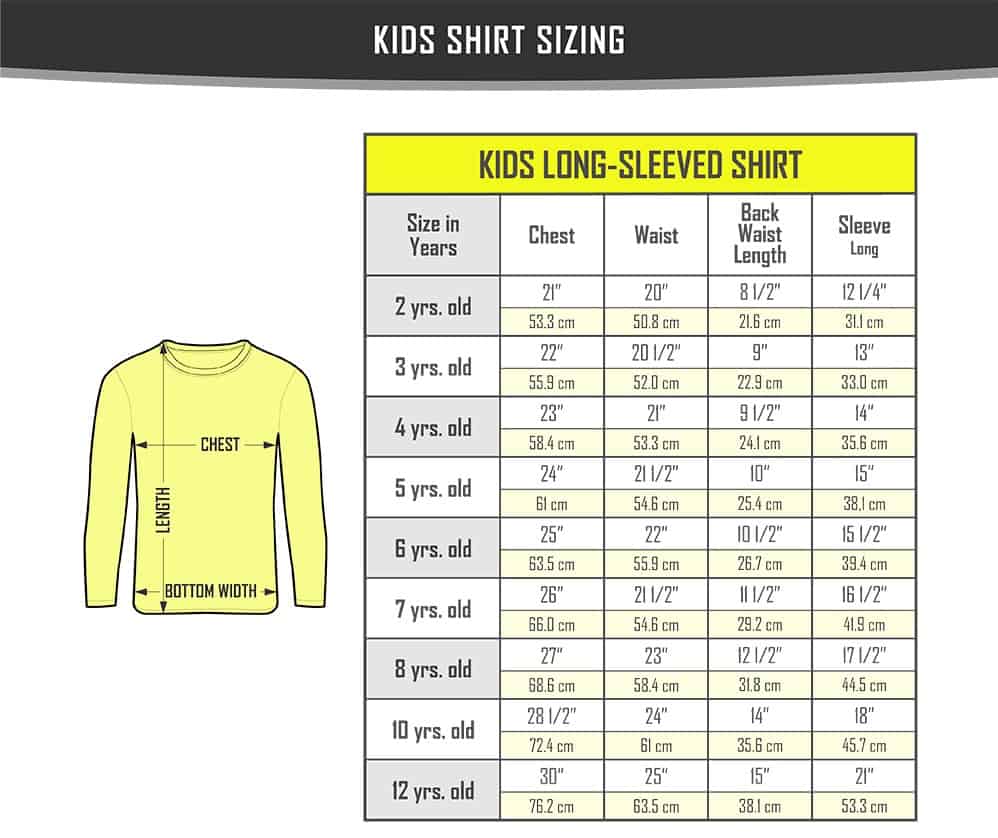
Use this chart for long-sleeved shirts sized by single age year. Chest and waist here are body measurements — measure the child, not a shirt they already own.
| Size (years) | Chest | Waist | Back waist length | Sleeve |
|---|---|---|---|---|
| 2 years | 21″ / 53.3 cm | 20″ / 50.8 cm | 8½” / 21.6 cm | 12¼” / 31.1 cm |
| 3 years | 22″ / 55.9 cm | 20½” / 52.0 cm | 9″ / 22.9 cm | 13″ / 33.0 cm |
| 4 years | 23″ / 58.4 cm | 21″ / 53.3 cm | 9½” / 24.1 cm | 14″ / 35.6 cm |
| 5 years | 24″ / 61.0 cm | 21½” / 54.6 cm | 10″ / 25.4 cm | 15″ / 38.1 cm |
| 6 years | 25″ / 63.5 cm | 22″ / 55.9 cm | 10½” / 26.7 cm | 15½” / 39.4 cm |
| 7 years | 26″ / 66.0 cm | 21½” / 54.6 cm * | 11½” / 29.2 cm | 16½” / 41.9 cm |
| 8 years | 27″ / 68.6 cm | 23″ / 58.4 cm | 12½” / 31.8 cm | 17½” / 44.5 cm |
| 10 years | 28½” / 72.4 cm | 24″ / 61.0 cm | 14″ / 35.6 cm | 18″ / 45.7 cm |
| 12 years | 30″ / 76.2 cm | 25″ / 63.5 cm | 15″ / 38.1 cm | 21″ / 53.3 cm |
* A note on the 7-year waist figure. This chart lists the 7-year waist as 21½” — smaller than the 6-year waist of 22″. That is almost certainly an error carried in the original chart rather than a real size drop, and we are leaving it visible rather than quietly smoothing it over. Treat the 7-year waist as roughly 22½”, between the 6-year and 8-year values, and measure to be sure.


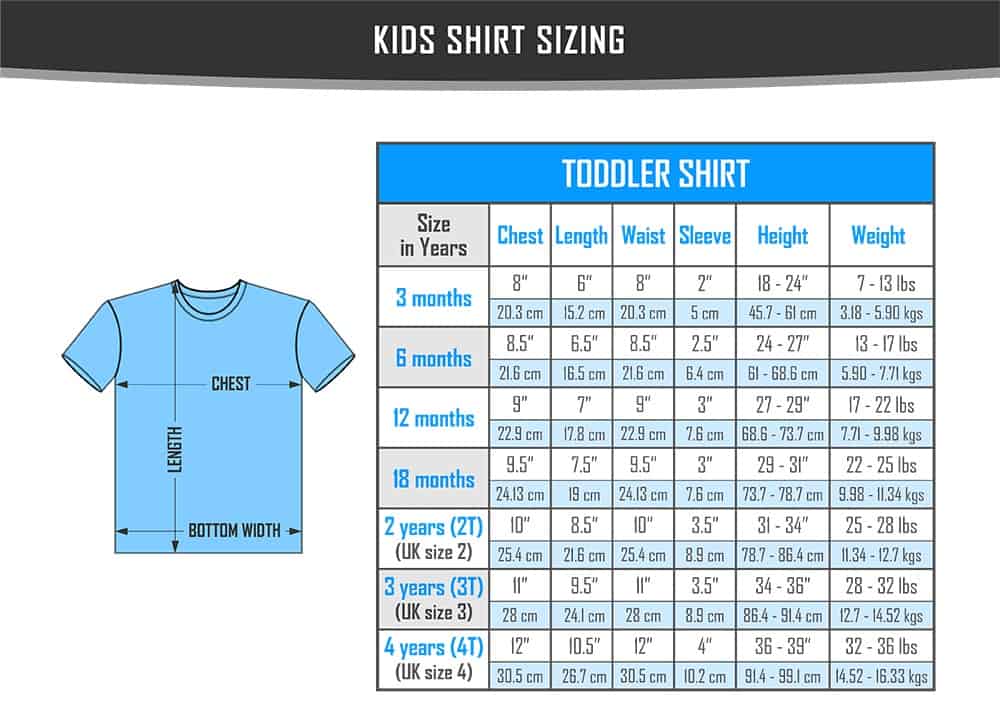
Toddler shirt size chart: 3 months to 4T
Toddler sizes run from 3 months to 4T and are set by height and weight more than by age. A 12-month size fits a child roughly 27–29 inches tall and 17–22 pounds. If your child is at the top of a weight band, go up a size — toddler shirts are cut close and a snug one lasts weeks, not months.
| Size | Chest | Length | Waist | Sleeve | Height | Weight |
|---|---|---|---|---|---|---|
| 3 months | 8″ / 20.3 cm | 6″ / 15.2 cm | 8″ / 20.3 cm | 2″ / 5 cm | 18–24″ / 45.7–61 cm | 7–13 lb / 3.2–5.9 kg |
| 6 months | 8½” / 21.6 cm | 6½” / 16.5 cm | 8½” / 21.6 cm | 2½” / 6.4 cm | 24–27″ / 61–68.6 cm | 13–17 lb / 5.9–7.7 kg |
| 12 months | 9″ / 22.9 cm | 7″ / 17.8 cm | 9″ / 22.9 cm | 3″ / 7.6 cm | 27–29″ / 68.6–73.7 cm | 17–22 lb / 7.7–10.0 kg |
| 18 months | 9½” / 24.1 cm | 7½” / 19 cm | 9½” / 24.1 cm | 3″ / 7.6 cm | 29–31″ / 73.7–78.7 cm | 22–25 lb / 10.0–11.3 kg |
| 2 years (2T) UK size 2 |
10″ / 25.4 cm | 8½” / 21.6 cm | 10″ / 25.4 cm | 3½” / 8.9 cm | 31–34″ / 78.7–86.4 cm | 25–28 lb / 11.3–12.7 kg |
| 3 years (3T) UK size 3 |
11″ / 28 cm | 9½” / 24.1 cm | 11″ / 28 cm | 3½” / 8.9 cm | 34–36″ / 86.4–91.4 cm | 28–32 lb / 12.7–14.5 kg |
| 4 years (4T) UK size 4 |
12″ / 30.5 cm | 10½” / 26.7 cm | 12″ / 30.5 cm | 4″ / 10.2 cm | 36–39″ / 91.4–99.1 cm | 32–36 lb / 14.5–16.3 kg |

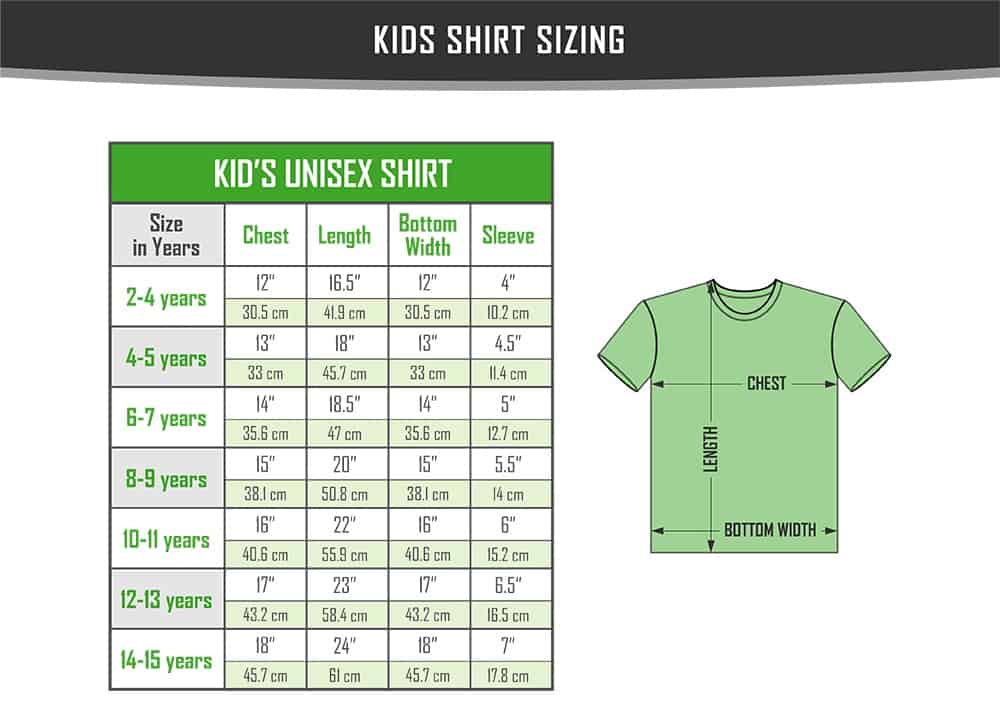
Kids unisex T-shirt size chart
Careful: the numbers in this chart are garment measurements, not body measurements. A unisex tee listed at a 14-inch chest is measured flat across the shirt from armpit to armpit — that is roughly a 28-inch body chest once you double it. This is why a “14-inch chest” tee fits a 6–7 year old whose actual chest measures 25–26 inches, and it is the single biggest source of confusion in kids shirt sizing.
| Size (years) | Chest (flat) | Length | Bottom width | Sleeve |
|---|---|---|---|---|
| 2–4 years | 12″ / 30.5 cm | 16½” / 41.9 cm | 12″ / 30.5 cm | 4″ / 10.2 cm |
| 4–5 years | 13″ / 33 cm | 18″ / 45.7 cm | 13″ / 33 cm | 4½” / 11.4 cm |
| 6–7 years | 14″ / 35.6 cm | 18½” / 47 cm | 14″ / 35.6 cm | 5″ / 12.7 cm |
| 8–9 years | 15″ / 38.1 cm | 20″ / 50.8 cm | 15″ / 38.1 cm | 5½” / 14 cm |
| 10–11 years | 16″ / 40.6 cm | 22″ / 55.9 cm | 16″ / 40.6 cm | 6″ / 15.2 cm |
| 12–13 years | 17″ / 43.2 cm | 23″ / 58.4 cm | 17″ / 43.2 cm | 6½” / 16.5 cm |
| 14–15 years | 18″ / 45.7 cm | 24″ / 61 cm | 18″ / 45.7 cm | 7″ / 17.8 cm |

How to measure your child for a shirt
You need four numbers, and a soft cloth tape. Measure over a thin t-shirt, not over a jumper, and keep the tape snug without compressing. Have your child stand relaxed with arms down — arms up changes the chest reading by an inch or more.
- Chest. Around the fullest part of the chest, under the armpits, tape level all the way round.
- Waist. Around the natural waist — the narrowest point, usually just above the belly button. Don’t pull it in; let them breathe normally.
- Back waist length. From the bony bump at the base of the neck straight down the spine to the natural waist. This is what decides whether a shirt sits right or rides up.
- Sleeve. From the centre back of the neck, across the shoulder, down the slightly bent arm to the wrist bone.
Between two sizes? Go up.
On shirts, always round up. A size too big is a shirt they grow into over a season; a size too small is one they refuse to wear by next month. The exception is anything fitted for a uniform or a performance layer, where a loose fit defeats the purpose.
Why the same child takes different sizes at different brands
Kids apparel sizing is not standardised in the US the way footwear or safety equipment is. Two shirts both labelled “size 6” can differ by a full inch across the chest, because each brand sets its own grading. Charts like the ones above describe general US kids sizing and get you to the right starting point — but before you order, open the specific brand’s own chart and compare it against your child’s measurements. If the brand doesn’t publish one, that itself tells you something.
Sources and verification
The three charts above are general US kids apparel sizing, transcribed in full from the charts published on this page. They are a starting point, not a brand guarantee: US children’s clothing sizes are not governed by a standard, and every manufacturer grades slightly differently. Always check the individual brand’s own size chart before buying, and measure your child rather than relying on their age.
Last verified: 5 August 2026. Spotted a number that looks wrong? Tell us — corrections get the chart re-checked and re-dated.