
Kids pants sizes follow the age year up to about size 7, then drift — a size 10 fits a typical 8-to-9-year-old, a size 14 a 10-to-11-year-old. Waist and inseam decide the fit, not the number on the label. Measure the natural waist and the inside leg, then read across.
Boys and girls sizing separates from around age six, mainly at the hip. Below that, toddler sizes (2T–5T) are shared.
Toddler pants size chart (2T–5T)
| Size | Age | Height | Metric | Weight | Hips | Waist | Inseam |
|---|---|---|---|---|---|---|---|
| 2T | 2 | 33½–35″ | 85.1–88.9 cm | 30–32 lb | 20½–21″ | 20½–21″ | 14–14¾” |
| 3T | 3 | 35–38″ | 88.9–96.5 cm | 32–35 lb | 21–22″ | 21–21½” | 14¾–15½” |
| 4T | 4 | 38–41″ | 96.5–104.1 cm | 35–39 lb | 22–23″ | 21½–22″ | 15½–17″ |
| 5T | 5 | 41–44″ | 104.1–111.8 cm | 39–45 lb | 23–24″ | 22–22½” | 17–18½” |
A pull-on pair with an adjustable inner waistband covers 2T through 5T without fighting a zipper:


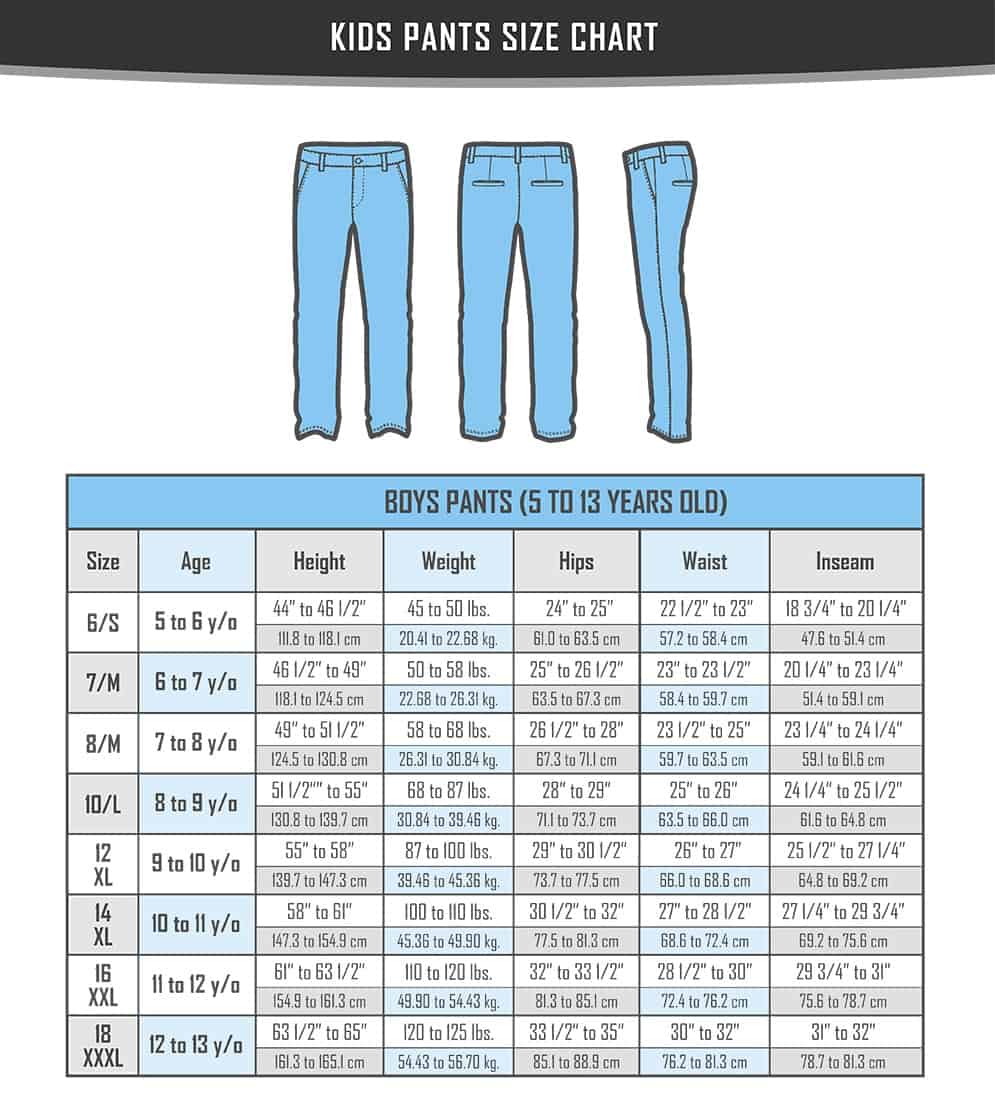
Boys pants size chart (5–13 years)
A boys size 10 fits roughly an 8-to-9-year-old — 51½ to 55 inches tall, 25–26 inch waist, 24¼–25½ inch inseam. Note how the size number pulls ahead of the age year from about size 10 onward; that is normal and not a mistake on the label.
| Size | Age | Height | Weight | Hips | Waist | Inseam |
|---|---|---|---|---|---|---|
| 6/S | 5–6 | 44–46½” | 45–50 lb | 24–25″ | 22½–23″ | 18¾–20¼” |
| 7/M | 6–7 | 46½–49″ | 50–58 lb | 25–26½” | 23–23½” | 20¼–23¼” |
| 8/M | 7–8 | 49–51½” | 58–68 lb | 26½–28″ | 23½–25″ | 23¼–24¼” |
| 10/L | 8–9 | 51½–55″ | 68–87 lb | 28–29″ | 25–26″ | 24¼–25½” |
| 12/XL | 9–10 | 55–58″ | 87–100 lb | 29–30½” | 26–27″ | 25½–27¼” |
| 14/XL | 10–11 | 58–61″ | 100–110 lb | 30½–32″ | 27–28½” | 27¼–29¾” |
| 16/XXL | 11–12 | 61–63½” | 110–120 lb | 32–33½” | 28½–30″ | 29¾–31″ |
| 18/XXXL | 12–13 | 63½–65″ | 120–125 lb | 33½–35″ | 30–32″ | 31–32″ |
For the 6/S–18/XXXL range, an adjustable waistband earns its keep between growth spurts:

Girls pants size chart (5–13 years)
| Size | Age | Height | Weight | Hips | Waist | Inseam |
|---|---|---|---|---|---|---|
| 6/S | 5–6 | 44–46½” | 45–50 lb | 24–25″ | 22½–23″ | 18¾–20¼” |
| 7/M | 6–7 | 46½–51″ | 50–57 lb | 25–27½” | 23–23½” | 20½–23″ |
| 8/M | 7–8 | 51–52½” | 57–65 lb | 27½–28″ | 23½–24″ | 23–24¼” |
| 10/L | 8–9 | 52½–55″ | 65–75 lb | 28–30″ | 24¼–25″ | 24¼–26″ |
| 12/L | 9–10 | 55–58″ | 75–86 lb | 30–32″ | 25–26″ | 26–27½” |
| 14/XL | 10–11 | 58–61″ | 86–100 lb | 32–34″ | 26–28″ | 27½–29″ |
| 16/XXL | 11–12 | 61–62½” | 100–108 lb | 34–36″ | 28–30″ | 29–29½” |
| 18/XXXL | 12–13 | 62½–64″ | 108–115 lb | 36–38″ | 30–32″ | 29½–30″ |
Same idea for girls’ sizing — internal adjustable elastic that grows with the size, not just the leg length:

Compared with boys at the same size, girls sizing runs slightly fuller at the hip and slightly narrower at the waist from about size 10 up. That gap widens through the teens.
How to measure your child for pants
Three numbers: waist, hips, inseam. Measure over thin clothing with a soft tape, snug but not pulled tight.
- Waist. Around the natural waist — the narrowest part, usually just above the belly button. Let them breathe normally; do not measure over a full nappy or a bulky waistband.
- Hips. Around the fullest part of the seat, feet together.
- Inseam. From the crotch straight down the inside of the leg to the ankle bone. Easiest done on a pair of trousers that already fit, laid flat.
Slim, regular or husky?
Many brands offer the same size in slim and husky (or plus) cuts. These change the waist while keeping the inseam — so if your child’s inseam matches a size but the waist gapes, take the slim; if the waist is tight but the length is right, take the husky. Sizing up to fix a waist problem just gives you trousers that are too long as well.
Between two sizes?
Go up, and check the inseam. Most kids trousers have adjustable elastic inside the waistband, so a slightly large waist is fixable in seconds while a short leg is not fixable at all.
Sources and verification
The charts above are general US kids apparel sizing. US children’s clothing sizes are not governed by a standard and every manufacturer grades differently — two pairs both labelled size 10 can differ by a full inch at the waist. Use these to find the right starting point, then check the specific brand’s own chart before ordering.
Last verified: 5 August 2026. Spotted a number that looks wrong? Tell us — corrections get the chart re-checked and re-dated.
More charts: every kids size chart in one place.