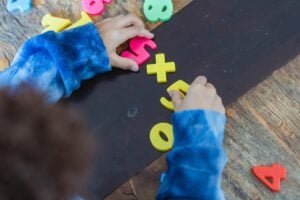

Most children are ready for organised sport at around five or six. Before that, free play builds the same coordination without the pressure. What changes with age is not just the sport but the gear — and gear that does not fit is the fastest way to make a child dislike a sport they would otherwise have loved.
This guide goes age by age: what most kids can handle, what they play, and exactly what you need to buy — with the sizing chart for each item, so you get it right the first time.
Ages 2–4: no equipment, just movement
Skip organised sport entirely at this age. Toddlers are still building the balance and body awareness that every sport later depends on. What helps most is unstructured movement — running, climbing, throwing, kicking a ball around the garden.
The one purchase worth making is a balance bike. Children who start on one at two or three usually skip stabilisers altogether, because they have already learned the hard part — staying upright while moving.
- Balance bike, 10–12 inch wheel — see the kids bike size chart for the inseam measurement that decides the size
- A soft ball they can kick and throw without hurting anyone
- A properly fitted helmet — ASTM F1447 or CPSC certified
Ages 5–7: first team sports
This is where organised sport usually starts. T-ball, small-sided soccer, beginner swimming, first golf lessons. Sessions are short, rules are loose, and the goal is enjoyment rather than competition. Expect a child this age to change their mind about which sport they love roughly every eight weeks — which is a good argument for renting or buying secondhand.
What to buy at 5–7
- T-ball or first baseball: a 24–26 inch bat. Check the kids baseball bat size chart — at this age the reach test matters more than the length chart, because a bat they cannot hold out steady is a bat they cannot swing.
- Soccer: a size 3 ball, shin guards, and boots. Nothing else.
- First golf: a cut-down three or four club set. The kids golf club size chart goes by height, not age — most children this age are on a 39 to 45 inch fitting.
- Bike: moving from balance bike to a 14 or 16 inch pedal bike.
- First skis: if you ski as a family, a 70–90 cm ski. See the kids ski size chart.
Ages 8–10: specialising, and gear that actually matters
Around eight, children start choosing. They will drop three sports and keep one or two, and the one they keep is usually the one they feel competent at. Equipment fit starts to have a real effect on that feeling of competence — a bat that is too heavy or a bike that is too big holds a child back in a way they experience as “I am bad at this”.
What to buy at 8–10
- Baseball: 28–29 inch bat, drop 10, plus a glove and a batting helmet. Check league rules — Little League and most youth baseball now require the USA Baseball (USABat) stamp, and a travel-ball USSSA bat is usually not legal in Little League play.
- Soccer: size 4 ball from age eight.
- Basketball: a size 5 (27.5 inch) youth ball.
- Golf: 48–54 inch fitting, and this is the age where a proper fitting starts to pay off.
- Bike: 20 inch wheel, often their first bike with gears.
- Snowboarding: most children can start around seven or eight. See the kids snowboard size chart — board length goes by weight more than height.
Ages 11–14: adult-scale equipment
Growth spurts make this the most expensive stage. A child can move up two bat sizes in a season. Buying ahead still does not work — a bat two inches too long teaches a compensating swing — but this is the age to look seriously at secondhand, because everyone else is outgrowing gear at the same rate.
What to buy at 11–14
- Baseball: 30–32 inch bat, moving toward a lower drop as they get stronger.
- Soccer: size 5 ball, the adult size, from about age twelve.
- Basketball: size 6 (28.5 inch), and size 7 for boys from around fourteen.
- Bike: 24 inch wheel, then a small adult frame from roughly 145 cm tall.
- Golf: 57–66 inch fitting, approaching adult club length.
Two more charts for the sports above: basketball size by age (and the rim height that goes with it) and hockey stick sizing for both field and ice.
Two rules that apply at every age
Never size up on equipment
Clothing you buy a size large and they grow into it. Equipment does not work that way. A bat, a bike, a pair of skis or a set of golf clubs that is too big changes the movement itself — and the compensating technique a child learns takes a coach a season to undo. Fit the child you have today.
Anything safety-rated needs checking on the actual child
Helmets, protective padding and life jackets have standards behind them — ASTM F1447 for bike helmets, NOCSAE for football, ASTM F2040 for snow sports, US Coast Guard type ratings for life jackets. A size chart gets you close. For these items, an in-person fit check is what gets you right, and it is worth the trip.
Every size chart in one place
Whichever sport your child lands on, the sizing is collected here: kids size charts — bats, golf clubs, bikes, skis, snowboards, plus apparel.
Sources and verification
Ball sizes by age follow standard youth league conventions. Bat certification requirements come from Little League Baseball and USA Baseball; travel-ball requirements from USSSA. Helmet standards referenced are ASTM F1447, ASTM F2040 and NOCSAE; life jacket ratings from the US Coast Guard. League rules are revised periodically — confirm your specific league’s current requirement before buying anything with a certification stamp.
Last verified: 5 August 2026. Spotted something that looks wrong? Tell us.